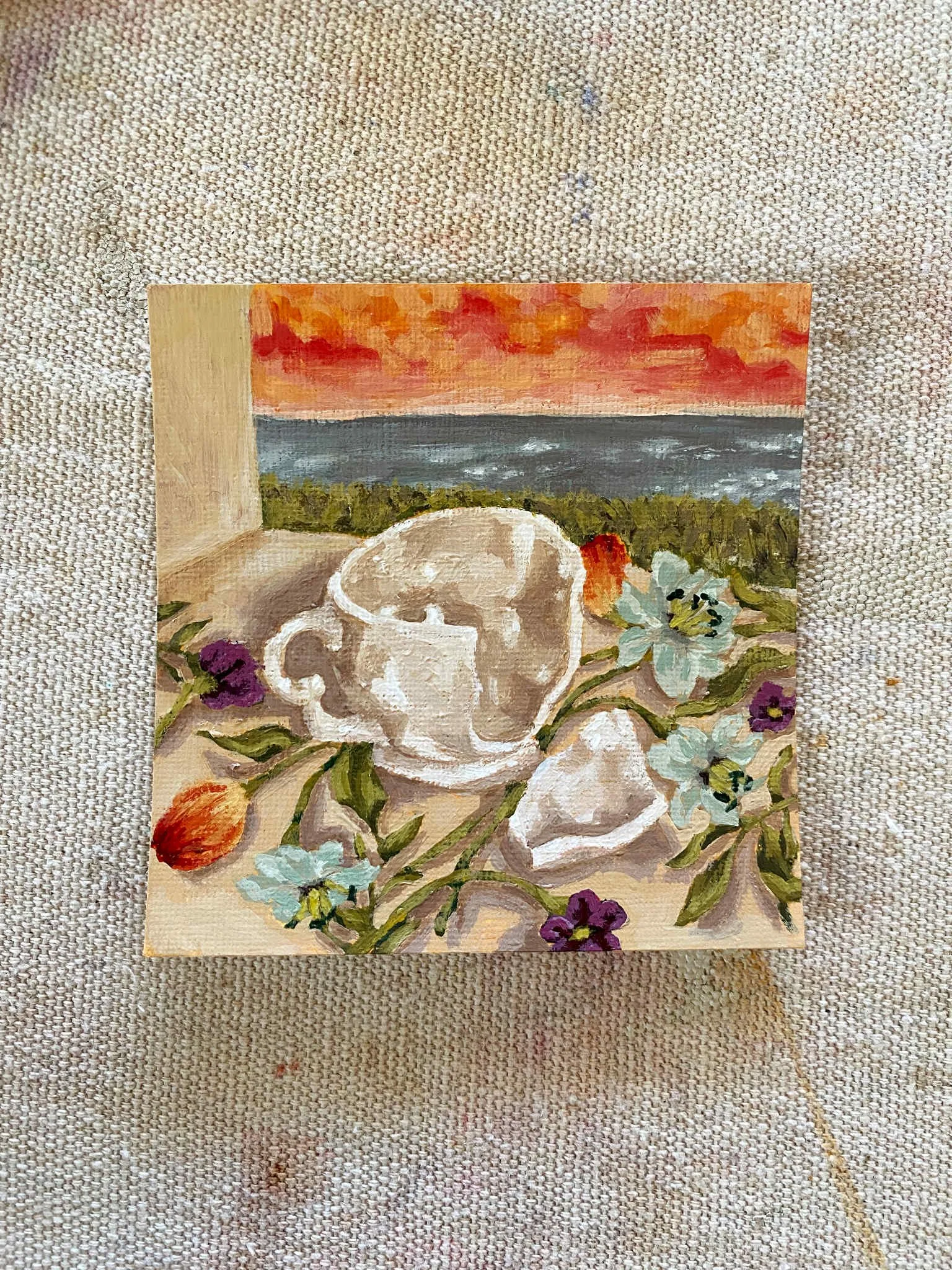
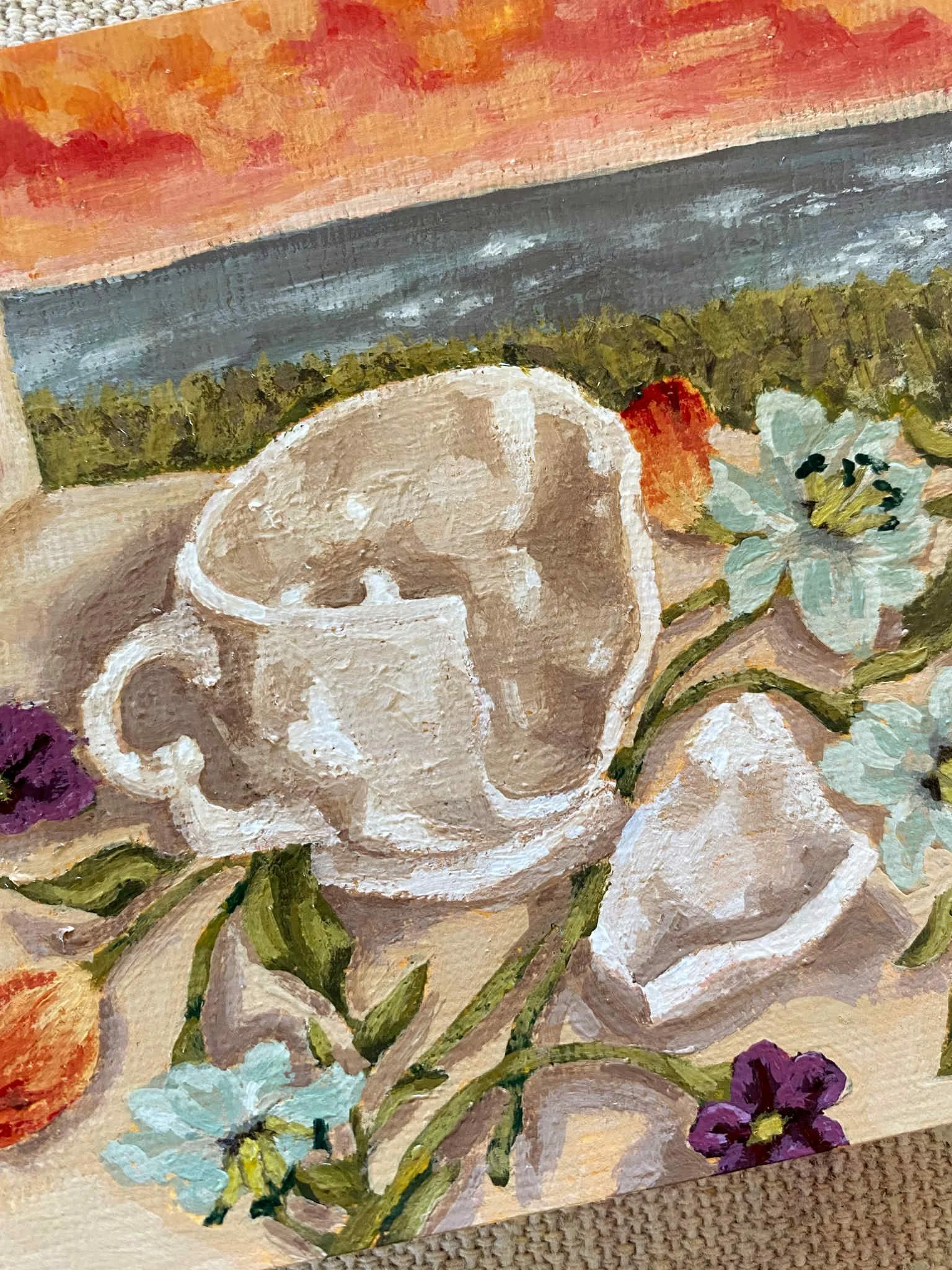
4×4 inches
Acrylic on paper
Signed and dated on the back
This piece is part of a series of 9 paintings that were created as I processed my emotions about my grandma’s life, her experiences with Alzheimers disease, and her passing. I found a bit of comfort in color and subject: in rendering the simple warmth of everyday objects like a cup of tea or a bouquet of flowers. These works are meant to honor simple moments as they come — even those that are soon-to-be forgotten or those that have long since passed — as they are all the embedded makings of a precious life.
Here’s a bit of my writing that explains the meaning behind it:
While painting this piece, I thought about how many people talk about the beauty of Kintsugi, the Japanese art form where they mend broken pottery with gold, highlighting the repair instead of hiding it.
And it’s for good reason, the technique creates truly beautiful art.
But in this time of grieving my Grandma with Alzheimer’s, I thought about how there is still a beauty to things that will never be repaired. People and things that are broken and can’t be salvaged, even with gold, are still worthy of our attention and our love.
It’s harder for many of us to sit with that, though. It’s always easier to find the cracks beautiful once they are fixed.
Sitting with broken things and honoring them as they are, that’s so hard. Sitting with my grandmother at her worst, when she was unable to speak or sit up or eat or do anything but sleep, was hard.. but I think it held an indelible cosmic significance all the same.
But I think love in broken pieces is still worthwhile. I think broken things matter.
Sometimes, in my grief, I have found myself becoming upset when other people can’t see the beauty in the broken pieces like I do — when they cant sit with the brokenness, and instead give into that “fixing” impulse.
This painting was an opportunity for me to sit with the brokenness as much as I needed to, and honor it in its broken form, without ever intending to “fix” it. Where no one could rush me, and no one could touch it. Where I could honor all the parts of my grandma — not just her healthiest self, not just her best self, but her in her entirety, even in her weakness and her illness.
4×4 inches
Acrylic on paper
Signed and dated on the back
This piece is part of a series of 9 paintings that were created as I processed my emotions about my grandma’s life, her experiences with Alzheimers disease, and her passing. I found a bit of comfort in color and subject: in rendering the simple warmth of everyday objects like a cup of tea or a bouquet of flowers. These works are meant to honor simple moments as they come — even those that are soon-to-be forgotten or those that have long since passed — as they are all the embedded makings of a precious life.
Here’s a bit of my writing that explains the meaning behind it:
While painting this piece, I thought about how many people talk about the beauty of Kintsugi, the Japanese art form where they mend broken pottery with gold, highlighting the repair instead of hiding it.
And it’s for good reason, the technique creates truly beautiful art.
But in this time of grieving my Grandma with Alzheimer’s, I thought about how there is still a beauty to things that will never be repaired. People and things that are broken and can’t be salvaged, even with gold, are still worthy of our attention and our love.
It’s harder for many of us to sit with that, though. It’s always easier to find the cracks beautiful once they are fixed.
Sitting with broken things and honoring them as they are, that’s so hard. Sitting with my grandmother at her worst, when she was unable to speak or sit up or eat or do anything but sleep, was hard.. but I think it held an indelible cosmic significance all the same.
But I think love in broken pieces is still worthwhile. I think broken things matter.
Sometimes, in my grief, I have found myself becoming upset when other people can’t see the beauty in the broken pieces like I do — when they cant sit with the brokenness, and instead give into that “fixing” impulse.
This painting was an opportunity for me to sit with the brokenness as much as I needed to, and honor it in its broken form, without ever intending to “fix” it. Where no one could rush me, and no one could touch it. Where I could honor all the parts of my grandma — not just her healthiest self, not just her best self, but her in her entirety, even in her weakness and her illness.